When Doing Something Random Teaches You More Than the Plan
This is not about saving the day — it’s about the quiet magic of doing something new.

I spend most of my days as a creative director doing what creative directors do: consulting. Sitting with clients, listening to what they’re saying and what they’re not saying, translating their vibes (and sometimes their panic) into creative solutions. It’s what I’m good at. It’s my lane.
But this week, life decided to throw me out of that lane.
We’ve had issues with an internal document for a while. We tried everything we could think of, but every solution was basically the same idea in a different hat: “evolve the document.” But something wasn’t clicking. And then—without a grand plan or a TED Talk moment—I found myself doing something I almost never do: working alone, building a prototype, using Ai tools. Not consulting about it. Not art directing it. Actually building it.
And here’s the first breakthrough: I was having fun.
Not “this is professionally satisfying” fun. Not “look at me, being efficient” fun. Real, simple, being engaged. The kind that makes two hours disappear. The problem wasn’t about perfecting our document—it was about creating the right tool to make it work. And actually building it made that painfully, beautifully obvious.
Then something unexpected happened. The AI prototyping tool I was using isn’t designed for brainstorming—it’s meant for builders. But I started using it to think, to explore, to play. And it worked. There I was, MacGyvering an ideation process out of a tool that didn’t sign up for the job. A colleague saw me doing it… and joined in. Good thing!
A Mug, a Curve, and a Lesson
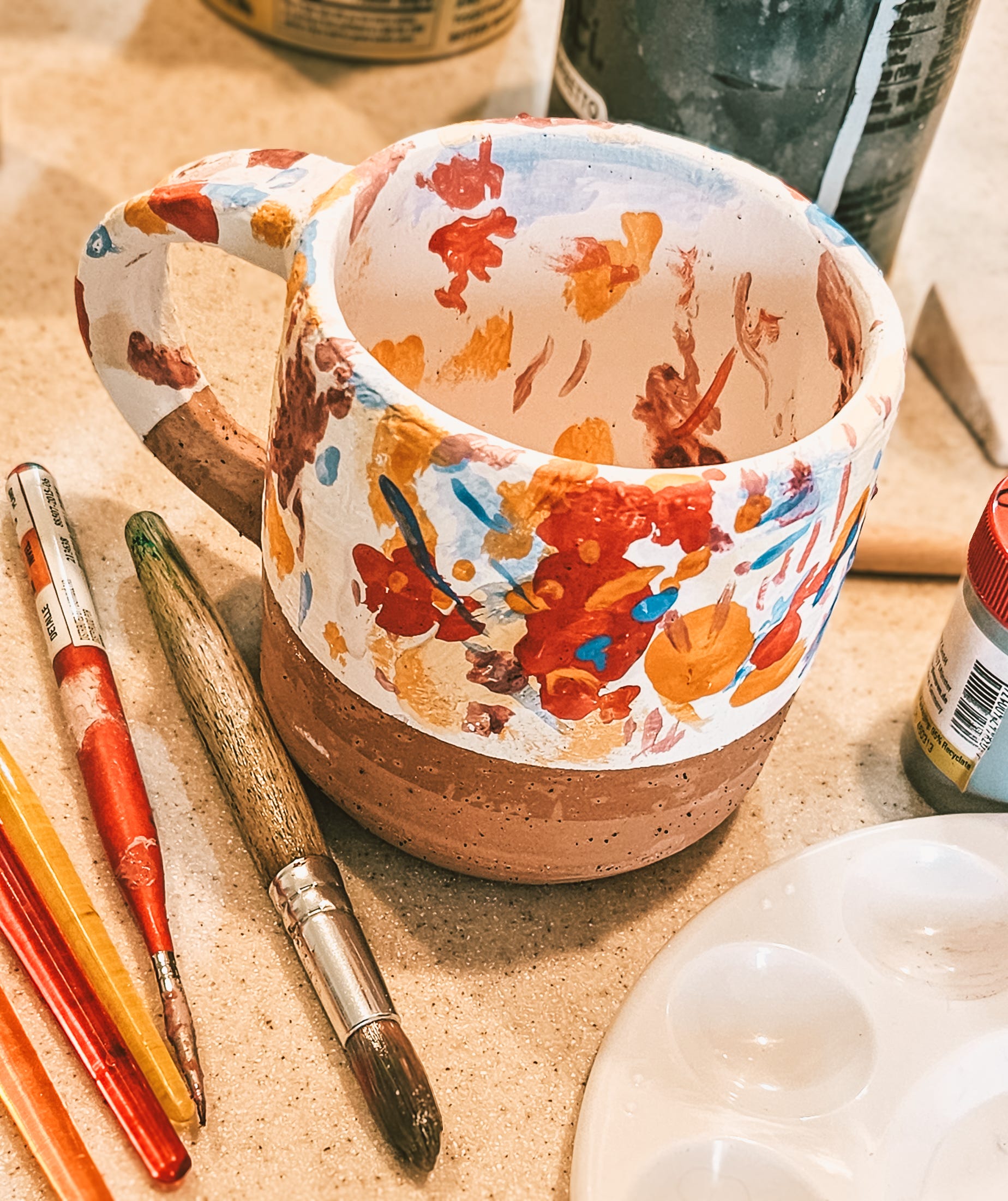
The second curveball came later that week. My mother-in-law—who’s a wonderful ceramic artist—asked if I wanted to paint some coffee mugs to bring as gifts to my family in Costa Rica.
My practical brain said, “Just buy something at the store and call it a day.”
But another part of me whispered, “This could be fun.” Also, mugs don’t talk back. So I said yes.
Painting a three-dimensional object is nothing like the clean, controlled world of digital design. You’re rotating it constantly, figuring out how the design flows around curves, where someone’s hands will hold it, how it looks from every angle. It’s physical. Messy. Demanding. Completely outside my usual creative territory.
And again—that feeling of being engaged.
I’m not saying I’m good at painting ceramics (one of those mugs may now have what we’ll politely call “personality”), and I’m definitely not calling myself a developer. But both experiences cracked something open in how I think about my regular work.
The Intersection Effect
There’s a concept from The Medici Effect by Frans Johansson that explains what happened this week. Big innovations rarely come from digging deeper into what you already know. They happen at the intersection—when your hard-earned expertise collides with something completely different. That’s where new ideas are born.
It comes from picking up a tool you’ve never touched before. From using a prototyping platform for brainstorming. From painting a curved surface and realizing how three-dimensional thinking can shape your next design challenge.
The intersection is where ideas from different worlds bump into each other, spill their coffee, and end up creating something new.
So?
If you’re good at what you do, you’ve spent years building that expertise. You know the shortcuts. You can spot patterns others miss. That’s gold.
But that strength can also quietly become a cage. It makes you efficient at solving problems your way. It keeps you in your lane because your lane works. And that’s exactly when breakthroughs stop happening.
The real magic often hides at the edges—in the unexpected tool, the random conversation, the side project that technically “isn’t your job.”
The breakthrough isn’t just the thing you build in those moments. It’s what that moment gives back to your everyday work. It’s your colleague seeing you prototype in an unconventional way and thinking, “Wait, I could do that too.” It’s your brain applying what it learned from painting mugs to your next project. It’s remembering why you fell in love with creativity in the first place.
Find the Link
You don’t have to quit your job and become a ceramicist. Or a developer. Or that person who suddenly starts wearing linen shirts and moving to Bali to “follow their muse.”
You just have to say yes to the unexpected thing.
That thing slightly outside your role.
The tool that wasn’t “meant” for this.
The conversation with someone who does something completely different.
Exciting and scary usually travel together. But please—let’s not take this into an extreme. We’re talking creative detours, not life-altering plot twists.